The history of Preußen Münster
Milestones and background from the club's history, in chronological order.
Categories
Competitions
Nicknames through the years Three names tell a story of near misses, late goals and an unbeaten season. Read the storiesClose the stories
1900–1909
Schoolboys found FC Preußen
Pupils at Münster’s Oberrealschule founded Fußballclub Preußen Münster. They chose black, white and green; the first flag bore the initials FCP and the founding year 1906.
Five goals in the first official match
At the military drill ground at Loddenheide, FC Preußen won their first official match 5–0 against FC 1899 Osnabrück. The friendly marked the beginning of the club’s recorded match history.

1910–1919
A new home at the Münstermannplatz
The club moved from Loddenheide to a meadow made available by the farmer Münstermann on Hammer Straße. The Münstermannplatz remained their home ground until the move to the new stadium.
1920–1929
From football club to sports club
FC Preußen Münster became SC Preußen Münster. With tennis and athletics joining football, the association had developed into a sports club.
The first live football broadcast on German radio
The district-league match against BFC Arminia Bielefeld at the Münstermannplatz became a broadcasting milestone. Bernhard Ernst commentated for Westdeutsche Funkstunde; Preußen lost 5–0.
A cable almost three kilometres long was laid for the broadcast. Ernst, himself a Preußen member, went on to become a pioneer of German sports radio.
The stadium on Hammer Straße opens
 Preußen Münster1:4
 SC Victoria HamburgLocation: Münster Stadium: Städtisches Stadion an der Hammer Straße
Mayor Georg Sperlich opened the new ground. Preußen lost the opening match 4–1 to SC Victoria Hamburg; the stadium became the club’s permanent home.

1950–1959
Eight goals take Preußen to the championship final
An 8–2 away win against Tennis Borussia Berlin took Preußen to the German Championship final. Nürnberg’s simultaneous 4–1 win against Hamburger SV left both clubs on eight points; Münster advanced on the better goal average.
Preußen’s group record was 22 goals scored and 16 conceded, compared with Nürnberg’s 17 and 13. The tie-breaker was the ratio of goals scored to goals conceded. The attack featuring Fiffi Gerritzen, Adi Preißler, Sigi Rachuba, Rudi Schulz and Josef Lammers became known as the “100,000-Mark-Sturm”.
German runners-up at the Olympiastadion
Preußen led through Fiffi Gerritzen in the Berlin final but lost 2–1 to Kaiserslautern. Ottmar Walter turned the match with two goals; finishing runners-up remained Münster’s greatest achievement in the national championship.


1960–1969
The Bundesliga begins in Münster
As one of the 16 founding clubs, Preußen began their Bundesliga campaign with a 1–1 draw against Hamburger SV. Falk Dörr put Münster ahead before Charly Dörfel equalised late on. The packed Preußenstadion was one of the venues on the Bundesliga’s first matchday.
Relegation ends the sole Bundesliga season
A 4–2 defeat at Werder Bremen and Hertha’s 3–1 win against 1860 München sealed relegation. With one match left, Preußen could reach at most 23 points, while Hertha already had 24.
Preußen subsequently played in the second-tier Regionalliga West. The 2. Bundesliga was founded ten years later. The Bundesliga founding club has yet to return to the top flight.
West German Cup winners without a separate final
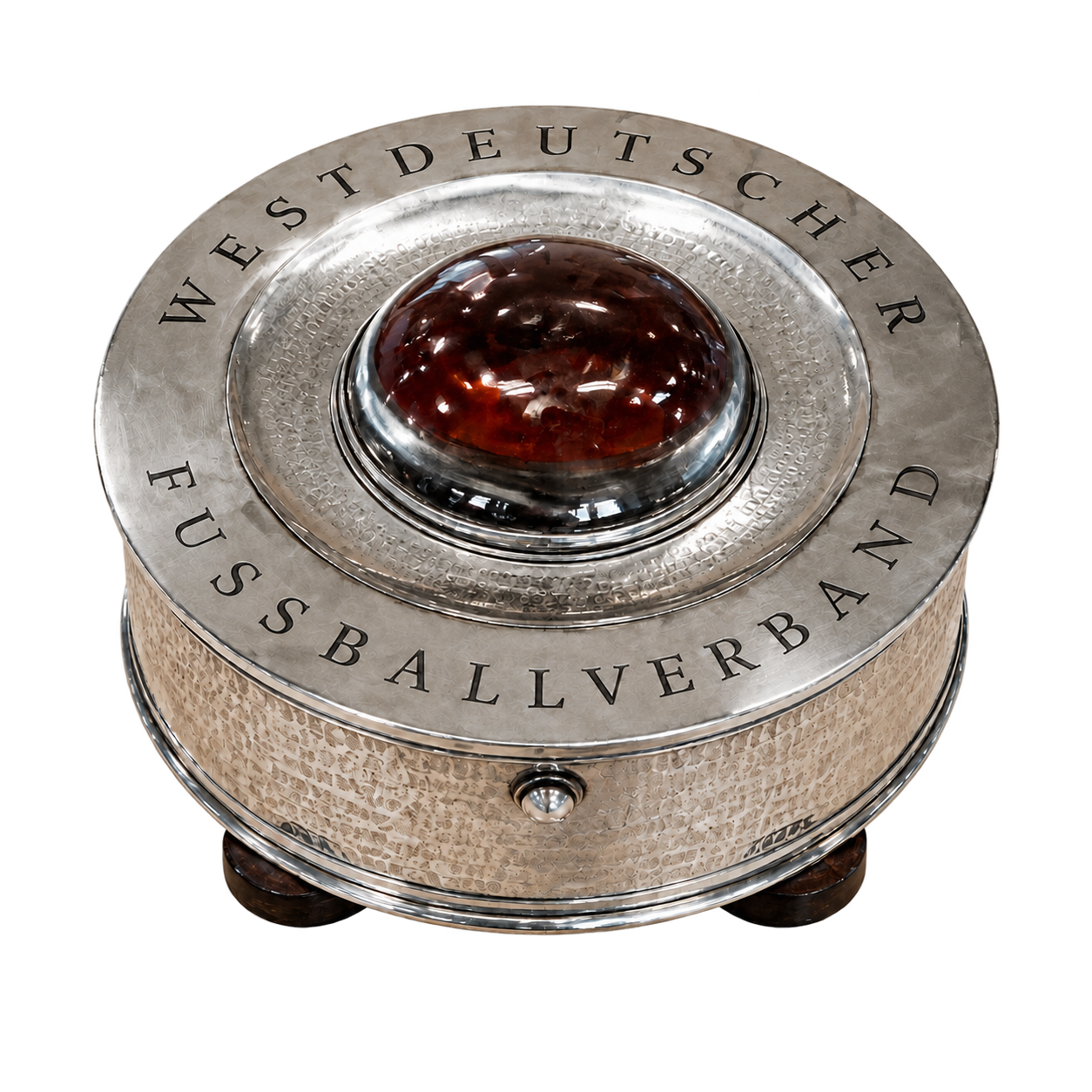
A 3–2 win at Wormatia Worms on January 4, 1969 took Preußen to the DFB-Pokal round of 16. As the most successful West German cup entrant outside the Bundesliga, Münster was retrospectively recognised as the 1969 West German Cup winner. No separate final was played.



1970–1979
The new 2. Bundesliga Nord begins
Preußen was a founding club of the two-section 2. Bundesliga. Their northern-section debut ended in a 3–1 defeat at Bayer Uerdingen; after ten years in the Regionalliga, the club remained in the second tier.
Four goals against Dortmund
The 4–1 win against Borussia Dortmund was a highlight of the club’s second-division years at the Preußenstadion. Münster finished third that season; further close attempts in 1978 and 1979 also fell short of a Bundesliga return.

1980–1989
Thirteenth in the final northern-section season
A 3–1 defeat at Holstein Kiel closed the final season of the two-section 2. Bundesliga. Münster finished 13th with 36 points, but admission to the new single division also depended on a multi-year qualification ranking.
Excluded from the new single second division
Mönchengladbach’s 7–1 win against Bayer Uerdingen made at least one northern Bundesliga relegation inevitable. This ruled out the last possible combination of results that could have admitted Münster in twelfth place in the qualification ranking.
The final positions in 1979, 1980 and 1981 were weighted once, twice and three times respectively. Münster ended with 62 ranking points in twelfth place. After 17 years in the second tier, the club moved into the Oberliga Westfalen.
A goalless draw secures the return
A 0–0 draw against MSV Duisburg secured second place in the promotion round’s northern group. Göttingen could no longer reach Münster’s ten points; Hellmut Horsch led Preußen back to the 2. Bundesliga after eight years.
Supporters carried Uli Gäher on their shoulders. Celebrations at the Jovel and on the Prinzipalmarkt became defining memories of that summer.



1990–1999
Back in the third tier after two years
A 3–2 defeat at SC Freiburg sealed relegation from the 2. Bundesliga. With one match remaining, Preußen could reach at most 31 points; sixteen rivals had already exceeded that total.
German amateur champions at the Bieberer Berg
Preußen won the German Amateur Championship final 1–0 at Kickers Offenbach. Having topped the northern group, Uwe Leifeld’s first team claimed the national amateur title.
The first Westphalian Cup triumph
A 4–1 win in the final at TSG Dülmen gave Preußen their first Westphalian Cup. The success began a series of later victories in the regional association cup.


2000–2009
A century of Preußen Münster
The club celebrated its 100th birthday. The schoolboys’ side founded in 1906 had become a Münster football institution, with a history spanning the 1951 championship final and the foundation of the Bundesliga.
Into the fourth tier in the centenary year
Even a 3–1 win at Bayer Leverkusen II was insufficient on the final day. Erfurt stayed ahead of Münster on goal difference with equal points; the Hamburg and Bremen reserves each earned a point. Preußen was relegated from the Regionalliga Nord and entered the fourth tier for the first time.


2010–2019
Three goals secure a place in the 3. Liga
A 3–0 win against Borussia Mönchengladbach II made Preußen Regionalliga West champions and secured promotion to the 3. Liga. Münster’s 69 points put them beyond reach with three matches remaining.
Coach Marc Fascher led the club back out of the fourth tier. Since 2008, Preußen had played in the reorganised Regionalliga, which remained a fourth-tier competition.
Werder beaten in extra time
Preußen beat Bundesliga club Werder Bremen 4–2 after extra time in the DFB-Pokal first round. Matthew Taylor scored a hat-trick in one of the Preußenstadion’s memorable cup afternoons.
A fifth Westphalian Cup
A 3–0 win at Sportfreunde Siegen’s Leimbachstadion gave Preußen their fifth Westphalian Cup. The final of the 2013/14 competition was played in July.
New governing bodies for the professional company
Following the members’ vote to separate the professional business, the KGaA’s governing bodies were appointed. Bernhard Niewöhner took charge of commercial management; the parent association retained control through the general-partner company.


2020–2029
Relegation after nine 3. Liga seasons
A 3–0 defeat by Meppen and Zwickau’s 2–1 win against Chemnitz decided relegation. Before the final matchday, Preußen could still reach 42 points, while Zwickau already had 43.
Wegkamp’s penalty secures a sixth cup
At the Sportclub Arena in Verl, Preußen beat Sportfreunde Lotte 1–0. Gerrit Wegkamp converted the decisive penalty in the 85th minute to secure the club’s sixth Westphalian Cup.
Wolfsburg’s sixth substitution results in cup elimination
The DFB federal court upheld a 2–0 awarded victory for Preußen. Wolfsburg had won 3–1 after extra time on August 8, 2021 but used six substitutes instead of the permitted five. Münster consequently advanced to the second cup round.
Regionalliga champions and back in the 3. Liga
A 2–0 win against Fortuna Düsseldorf II secured the championship and promotion. Pursuers Mönchengladbach II drew 2–2 against Köln II; Münster led by 14 points with three matches remaining.
On the same day, Düren withdrew further legal challenges to the 2–0 awarded result of their unplayed match against Münster. The three points credited to Preußen therefore stood.
Back-to-back promotion to the 2. Bundesliga
Preußen won the final match against Unterhaching 2–0 to secure second place with 67 points. Under Sascha Hildmann, promotion from the Regionalliga was followed immediately by another step up: Münster returned to the second tier after 33 years.
A draw in Ulm secures survival
A 2–2 draw at SSV Ulm and Braunschweig’s 4–1 defeat by Nürnberg secured automatic survival. Preußen finished 15th with 36 points, clear of the relegation play-off place.
The road leads back to the 3. Liga
Fortuna Düsseldorf’s 3–1 win against Elversberg made survival impossible: even a victory could no longer take Preußen past enough rivals. Münster drew 1–1 with Darmstadt and was relegated after two second-division seasons.
The new Fiffi-Gerritzen-Kurve makes its league debut
The new eastern stand hosted its first league match during the 1–1 draw against Ingolstadt. The Fiffi-Gerritzen-Kurve brought the home support together; the redevelopment increased the LVM-Preußenstadion’s capacity to 13,945.